
Just read some interesting news in an article written by one of my favorite science journalist, Karin Boys, in the Swedish newspaper Dagens Nyheter:
they have found the physical existence of the magically beautiful E8-pattern – displayed in the image here below – one of the most complex mathematical concepts in the world which took weeks for a hall of super-computers to calculate and resulted in 400 000 printed pages. Researchers have been hoping that E8 is connected to the search for the great Theory of Unification, which shall bring together Einstein’s general theory of relativity and quantum mechanics (which is not possible with todays maths). And now symmetries from this pattern was discovered by a group of German and English physicists when they froze cobalt nitrate to the absolute 0-point, which made the electrons arrange themselves in kind of rows or chains. Then they exposed this to magnetic fields, and in the magnetic fluctuations which evolved the strikingly beautiful E8 pattern was spotted.
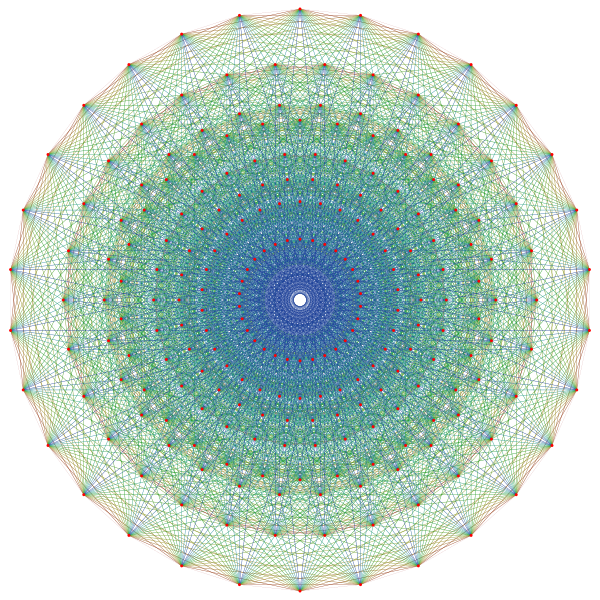
I mean, if it came down to looks I’d so far wote for this pattern to be the door to open the true Unification theory, it is just really amazing, isn’t it?!
This is not the first time mathematicians has calculated something which physicists did not yet know of, or they even considered impossible. The last time such a discovery was made was in 1974 by Sir Roger Penrose, who I actually made an 1 hour long interview with in the Vienna Riesenrad back in 2004. He calculated something called quasicrystals, a pattern of two shapes which can repeat endlessly without repeating a pattern. This was considered completely impossible, but was later found, for example in a type of stone in Siberia, and has even shown to have quite some practical use to it.
 spiritual empowerment